
Study design and population
This study was a parallel-group cluster randomized controlled trial with a pretest-posttest design in two family physician clinics in Pasargad County, southern Iran, during the second half of 2023.
The target population comprised exclusively older women, selected based on both epidemiological and practical considerations. From an epidemiological perspective, older women in Iran exhibit higher prevalence of mental health disorders and experience greater socioeconomic vulnerabilities than their male counterparts. From a practical standpoint, prevailing cultural norms in Pasargad necessitate gender-segregated educational sessions to ensure participant comfort and promote candid discussion of sensitive health-related issues. The presence of mixed-gender groups could potentially discourage participation and limit the openness of dialogue.
The sample size was calculated using the standardized effect size formula for two independent groups:
$$\:\text{n}\:=\frac{2(\text{Z}_{1}-{\upalpha\:}/2\:+\:\text{Z}_{1}-{\upbeta\:})^{2}\:}{\text{d}^{2}}\:$$
Using NCSS-PASS software (version 15),with a 95% confidence level (Z₁₋α/₂ = 1.96), 90% statistical power (Z₁₋β = 1.28), 0.05 significance level, and an effect size (d) of 0.57 derived from Abu-Salehi et al. (2021), which utilized similar educational interventions and the same outcome measure (GHQ-28) for mental health assessment in elderly populations41, the calculated sample size was 64 participants per group. Accounting for a 10% potential attrition rate, the final sample size was determined as 70 participants per group, totaling 140 elderly women divided equally into intervention and control groups.
This study used a modified two-stage cluster randomization approach. In the first stage, two clinics were randomly selected from five family physician clinics in Pasargad County using simple random sampling through a lottery method. In the second stage, these clinics were randomly allocated to either intervention or control groups through coin flip, with one clinic serving as the intervention group and the other as the control group. This cluster-level allocation was chosen to minimize potential contamination between study groups and facilitate the group-based educational intervention. The randomization process was conducted by an independent statistician who had no involvement in participant recruitment or intervention delivery. To ensure allocation concealment, participants were not informed of their clinic’s allocation status and were told only that they were participating in a health promotion study for elderly women. Following clinic allocation, we identified all registered elderly women in both clinics through the Integrated Health System (SIB) database. From the initial 172 elderly women identified, 153 met the eligibility criteria. The intervention clinic contained 74 eligible women, while the control clinic had 79 eligible participants. Given that the number of eligible participants in each clinic exceeded our required sample size, we randomly selected 70 participants from each clinic using a random number table in Microsoft Excel. Due to the educational nature of the intervention, blinding participants and facilitators was not feasible, resulting in an open-label design. However, we implemented single blinding for outcome assessors who collected and entered post-test data without knowledge of group allocation. Baseline characteristics were compared between groups to confirm the success of the randomization process.
Inclusion criteria
Participants were eligible to enroll in the study if they met the following criteria:
-
Aged 60 years or older.
-
Registered in the SIB electronic health system and under family physician coverage.
-
Ability to communicate (no severe visual or hearing impairments).
-
Ability to participate in light physical activities appropriate for older adults.
Exclusion criteria
Those meeting the following criteria were removed prior to randomization:
Withdrawal criteria
Participants would be withdrawn from the study if any of the following occurred:
-
Unwillingness to continue participation.
-
Absence from more than one educational session.
-
Death or migration of participant.
-
Failure to complete posttest questionnaire.
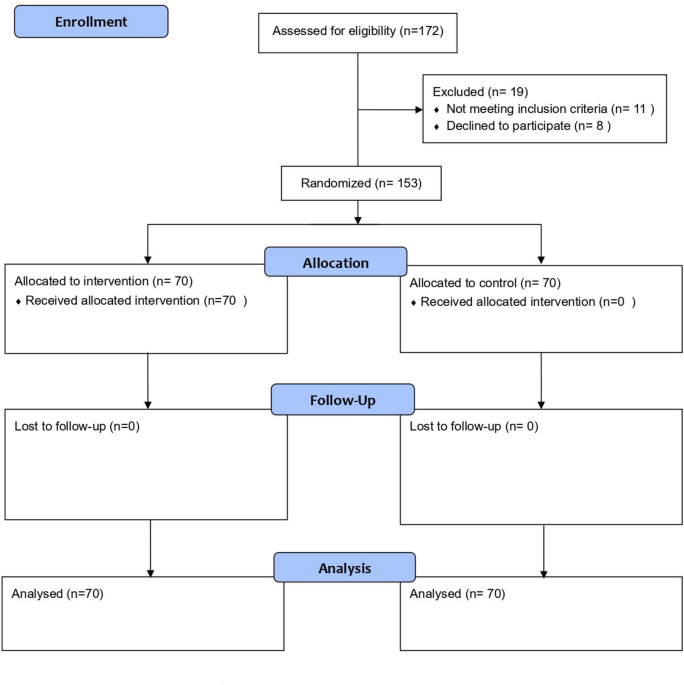
The participant recruitment and retention process are illustrated in the CONSORT flow diagram (Fig. 1).

CONSORT flow diagram illustrating participant flow from enrollment through analysis.
Data collection
The data collection tools included a researcher-designed demographic questionnaire and two standardized questionnaires, as detailed below:
Demographic questionnaire
The demographic questionnaire collected data on variables such as age, marital status, educational level, presence of chronic diseases, independent living (living alone), exposure to adverse life events, sleep problems, daily sleep duration, economic status, and perceived health status. Economic status was assessed using a three-point self-reported scale (“Poor/Below Poverty Line,” “Average,” “Above Average”), and perceived health status was assessed using a single-item question: “How would you rate your health status?“, measured on a four-point Likert scale (poor, moderate, good, excellent).
Health-Promoting lifestyle profile II (HPLP-II)
The Health-Promoting Lifestyle Profile II (HPLP-II) was developed by Walker et al. (1987) based on Pender’s Health Promotion Model. It consists of 52 items across six subscales: health responsibility, physical activity, nutrition, interpersonal relations, stress management, and spiritual growth/self-actualization. Items are scored on a five-point Likert scale ranging from “never” (1) to “always” (5). The total score ranges from 52 to 208, with higher scores indicating a more health-promoting lifestyle.
In this study, the nutrition subscale was excluded due to the intervention’s focus on mental health, resulting in a modified total score range of 45 to 180. Higher scores reflected a better lifestyle among participants.
Walker et al. reported a Cronbach’s alpha of 0.91 for the entire scale, with subscale reliabilities ranging from 0.79 to 0.9115. The Persian version of the questionnaire demonstrated a Cronbach’s alpha of 0.82 for the overall tool, with subscale reliabilities between 0.79 and 0.9142. In this study, reliability was confirmed using Cronbach’s alpha (pre = 0.863, post = 0.874) and McDonald’s omega (pre = 0.843, post = 0.867).
General health questionnaire (GHQ-28)
The General Health Questionnaire (GHQ-28) was developed by Goldberg et al. (1972) and consists of 28 items across four subscales: Somatic symptoms, Anxiety and insomnia, Social dysfunction, Severe depression. Items are scored on a four-point Likert scale, ranging from “not at all” (0) to “very much” (3), with a total score range of 0 to 84. Higher scores indicate poorer mental health.
Goldberg et al. (1972) reported Cronbach’s alpha values between 0.87 and 0.95 across different samples43. In the Persian version of the questionnaire, Nazifi et al. (2013) reported a Cronbach’s alpha of 0.92 for the overall tool, with subscale reliabilities above 0.7444. In this study, reliability was confirmed with Cronbach’s alpha (pre = 0.821, post = 0.879) and McDonald’s omega (pre = 0.835, post = 0.874).
Intervention and procedure
The educational intervention was developed based on Pender’s Health Promotion Model (HPM), and its constructs—such as perceived benefits, perceived barriers, self-efficacy, and others—were purposefully employed to enhance five key health-promoting behavior dimensions: health responsibility, physical activity, interpersonal relationships, stress management, and spiritual growth. Nutrition was intentionally excluded to emphasize behavioral and psychosocial factors affecting mental health.
The educational package was developed based on national, evidence-based guidelines, including Mental Health in Older Adults45 and Physical Activity in Older Adults46, which were commissioned by the Iranian Ministry of Health and distributed as official educational resources for primary healthcare providers. Content was adapted to suit the cognitive and cultural characteristics of the target population, using language simplification, culturally relevant examples, and modifications to physical activity content in alignment with local dress codes and privacy needs.
Before implementation, the content underwent pilot testing with 15 older women who met inclusion criteria but were not part of the main study sample. At the end of each pilot session, structured interviews and focus group discussions were conducted to evaluate participants’ comprehension, feasibility of the activities, and cultural appropriateness. Based on session-specific feedback, adjustments were made to pacing, exercise design, and terminology. All educational materials were reviewed by faculty experts in health education and gerontology to ensure clarity, scientific accuracy, and relevance to older adults.
The intervention consisted of seven weekly, 60-minute, in-person educational sessions conducted over eight consecutive weeks, with one consolidation week allowing participants to practice learned skills without new content introduction. Sessions were held at a comprehensive health center at 10:00 AM, a time selected based on participant preferences to ensure alertness and minimize fatigue. Participants were divided into groups of 7–10 to facilitate interaction while allowing for individual attention.
All sessions were facilitated by a licensed clinical psychologist with specialized training in geriatric health promotion and HPM. Each session addressed specific HPM constructs through varied teaching methods including interactive lectures, group discussions, practical demonstrations, role-playing exercises, and multimedia presentations. The physical environment included comfortable seating arrangements, adequate lighting and acoustics, easy restroom access, and light refreshments tailored to common chronic health conditions among participants, including diabetes, hypertension, and hyperlipidemia.
Participant comprehension was assessed through brief informal questioning during sessions and review of weekly assignment completion. Session evaluation forms assessed clarity of concepts, relevance to personal goals, and confidence in implementing strategies. SMS reminders were sent weekly to reinforce learning, and weekly practical challenges were assigned. To ensure intervention fidelity, all sessions used identical protocols and materials with no modifications were made to the core intervention protocol during implementation.
The control group received routine geriatric care provided by Family Physician Clinics but participated in no additional educational activities. To address ethical considerations, the educational package was offered to control group participants after study completion.
During the pretest phase, participants completed demographic questionnaires and baseline assessments. The intervention was delivered from April 30, 2023, to August 28, 2023. Posttest assessments were conducted one month after the final session to evaluate intervention effects. Detailed session content, objectives, teaching methods, target constructs, and weekly challenges are presented in Table 4.
Statistical analysis
The collected data were coded and analyzed using IBM SPSS Statistics version 27 (IBM Corp., Armonk, NY, United States). The normality of data distribution was assessed and confirmed using the Kolmogorov-Smirnov test. Demographic variables were analyzed using the Chi-square test and descriptive statistics, including mean and standard deviation. Economic status was dichotomized from three original categories into “Average and Above” versus “Poor/Below Poverty Line” due to small numbers in the “Above Average” group.
To compare means and examine differences between the two groups in the pre-test and post-test phases, independent t-test and Paired t-test were employed. To assess the effectiveness of the intervention, effect size indices including Cohen’s d and Cohen’s U3 were calculated. Cohen’s d was used to measure the standardized mean difference in both within-group comparisons (pre-test and post-test) and between-group comparisons (intervention and control). Additionally, Cohen’s U3 was employed to provide an intuitive interpretation of the intervention’s effect, indicating the percentage of participants in the intervention group who scored above the mean of the control group.
All statistical analyses were conducted in SPSS. However, Cohen’s U3, which is not supported in SPSS, was computed using the method described by Magnusson47. A significance level of less than 0.05 was considered for all statistical analyses.
link