

Strategic stability of the digital technology company
The expected revenues (\(E_11\), \(E_12\)) for the digital technology company when participating and not participating in value co-creation, as well as the average expected revenue (\(\overlineE_1 \)) are as follows:
$$\left\{ {\beginarray*20l \begingathered E_11 = yz\left( G_d + R_d + \lambda IQ – C_d – \Delta C_d \right) + y\left( 1 – z \right)\left( G_d + \lambda IQ – C_d – \Delta C_d \right) \\ + \left( 1 – y \right)z\left( G_d + \lambda \zeta IQ – C_d – \beta \Delta C_d \right) + \left( 1 – y \right)\left( 1 – z \right)\left( G_d + \lambda \alpha \zeta IQ – C_d – \beta \Delta C_d \right) \\ \endgathered \hfill \\ \begingathered E_12 = yz\left( G_d – C_d – L_d \right) + y\left( 1 – z \right)\left( G_d – C_d – L_d \right) \\ + \left( 1 – y \right)z\left( G_d – C_d – L_d \right) + \left( 1 – y \right)\left( 1 – z \right)\left( G_d – C_d – L_d \right) \\ \endgathered \hfill \\ \overlineE_1 = xE_11 + \left( 1 – x \right)E_12 \hfill \\ \endarray } \right.$$
(1)
The replicator dynamic equation is expressed as:
$$F\left( x \right) = \fracdxdt = x\left( {E_11 – \overlineE_1 } \right) = x\mkern 1mu \left( 1 – x \right)\left( \begingathered L_d – \Delta C_d \mkern 1mu \beta + \left( \beta – 1 \right)\Delta C_d \mkern 1mu y + R_d \mkern 1mu y\mkern 1mu z \hfill \\ + IQ\lambda \mkern 1mu \left( \mkern 1mu \alpha \mkern 1mu \zeta + y\left( 1 – \mkern 1mu \alpha \zeta \right) + \mkern 1mu \mkern 1mu \left( 1 – \mkern 1mu \alpha \right)\left( 1 – y \right)\zeta z \right) \hfill \\ \endgathered \right)$$
(2)
We obtain the first-order derivative of the replicator dynamic equation with respect to \(x\).
$$\fracdF\left( x \right)dx = \left( 2\mkern 1mu x – 1 \right)\mkern 1mu G\left( z \right)$$
(3)
where \(G\left( z \right) = – L_d + \Delta C_d \mkern 1mu \beta + \left( \beta – 1 \right)\Delta C_d \mkern 1mu y – R_d \mkern 1mu y\mkern 1mu z – IQ\lambda \mkern 1mu \left( \mkern 1mu \alpha \mkern 1mu \zeta + y\left( 1 – \mkern 1mu \alpha \zeta \right) + \mkern 1mu \mkern 1mu \left( 1 – \mkern 1mu \alpha \right)\left( 1 – y \right)\zeta z \right)\).
According to the stability theorem of differential equations, the strategic equilibrium points of the digital technology company must satisfy \(F\left( x \right) = 0\) and \({dF\left( x \right) \mathord\left/ \vphantom dF\left( x \right) dx \right. \kern-0pt dx} < 0\). It can be deduced that \({\partial G\left( z \right) \mathord\left/ \vphantom \partial G\left( z \right) \partial z \right. \kern-0pt \partial z} = \mkern 1mu \lambda \mkern 1mu \zeta I\mkern 1mu Q\left( 1 – \mkern 1mu y \right)\mkern 1mu \mkern 1mu \left( \alpha – 1 \right) – R_d \mkern 1mu y < 0\), implying that \(G\left( z \right)\) is a decreasing function of \(z\). We can derive \(G\left( z \right) = 0\) when \(z = z_1^* = \frac\Delta C_d \mkern 1mu \left( \left( 1 – y \right)\beta + y \right) – L_d – IQ\mkern 1mu \lambda \left( \alpha \zeta \left( 1 – y \right) + y \right)R_d \mkern 1mu y + \lambda \zeta IQ\left( y – 1 \right)\left( \alpha – 1 \right)\), at which point \({dF\left( x \right) \mathord\left/ \vphantom dF\left( x \right) dx \right. \kern-0pt dx} \equiv 0\), rendering it indeterminate for the digital technology company to ascertain a stable strategy. When \(z < z_1^*\), we derive \(G\left( z \right) > 0\) and \(\left. \fracdF\left( x \right)dx \right|_x = 0 < 0\), in which case \(x = 0\) becomes the evolutionary stable strategy (ESS) for the digital technology company. Conversely, when \(z > z_1^*\), we obtain \(G\left( z \right) < 0\) and \(\left. \fracdF\left( x \right)dx \right|_x = 1 < 0\), meaning that \(x = 1\) is ESS. The phase diagram for the strategy evolution of the digital technology company is shown in Fig. 2.
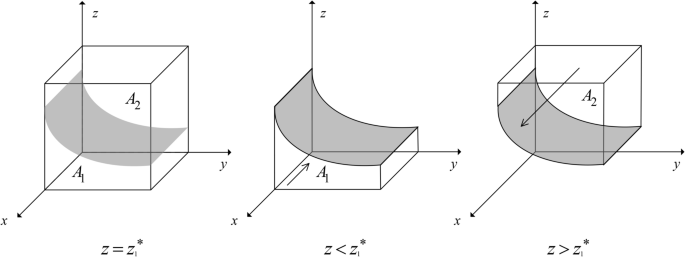
The phase diagram of the strategy evolution for the digital technology company.
Proposition 1:
During the evolutionary process, the probability of the digital technology company choosing to participate in value co-creation increases as the participation probabilities of the other two parties rise.
Proposition 1 indicates that the more actively the social organization operates and the stronger the service provider’s commitment to delivering high-quality services, the more inclined the digital technology company is to engage in value co-creation. Conversely, if the social organization neglects to provide digital training for the elderly, fails to promptly respond to their feedback, does not cooperate in the integration of digital resources, and exercises lax oversight over the service provider—allowing low-quality provider to access IESP—trust in IESP among the elderly diminishes. This erosion of trust leads to reduced user engagement and consequently lowers IESP’s revenue. In such a scenario, the digital technology company has little incentive to participate in value co-creation activities, such as iterative IESP updates. Therefore, for the sustainable development of IESP, it is imperative that the government strengthens oversight of the social organization’s operational behavior and establishes a quality standard and evaluation system for the elderly care service provider.
Proposition 2:
The probability of the digital technology company opting to engage in value co-creation strategy is positively correlated with the benefits derived from IESP (\(IQ\)), reputational gains (\(R_d\)), and reputational loss incurred from non-participation (\(L_d\)). Conversely, it is negatively correlated with the additional costs associated with value co-creation (\(\Delta C_d\)).
Proposition 2 indicates that increasing the revenue generated by IESP and reducing the additional operational costs for the digital technology company will encourage its participation in value co-creation. To achieve this, the government should enhance the promotion of IESP by collaborating with grassroots organizations, such as neighborhood committees and community councils, to carry out offline campaigns that bridge the digital divide among the elderly, thereby increasing the number of active users on IESP and achieving economies of scale. Additionally, the government can incentivize the digital technology company to engage in value co-creation by lowering the cost of data acquisition. This can be done by opening public data, establishing data-sharing platforms, and developing and promoting data standards. Moreover, both reputational gains and losses can motivate the digital technology company to participate in value co-creation. Thus, the government should prioritize subsequent collaborations with companies that actively engage in value co-creation. Conversely, for companies that fail to cooperate in maintenance after project acceptance, the government should reduce their opportunities for future collaboration.
Strategic stability of the social organization
The expected revenues (\(E_21\), \(E_22\)) for the social organization when participating and not participating in value co-creation, as well as the average expected revenue (\(\overlineE_2 \)) are as follows:
$$\left\{ {\beginarray*20l \begingathered E_21 = xz\left( \left( 1 – \lambda \right)IQ + R_s – C_s – \Delta C_s \right) + \left( 1 – x \right)z\left( I\widetildeQ – C_s – \Delta C_s \right) \\ + x\left( 1 – z \right)\left( \left( 1 – \lambda \right)IQ – C_s – \Delta C_s \right) + \left( 1 – x \right)\left( 1 – z \right)\left( I\widetildeQ – C_s – \Delta C_s \right) \\ \endgathered \hfill \\ \begingathered E_22 = xz\left( \left( 1 – \lambda \right)\zeta IQ – C_s – L_s \right) + \left( 1 – x \right)z\left( \zeta I\widetildeQ – C_s – L_s \right) \\ + x\left( 1 – z \right)\left( \left( 1 – \lambda \right)\alpha \zeta IQ – C_s – L_s \right) + \left( 1 – x \right)\left( 1 – z \right)\left( \alpha \zeta I\widetildeQ – C_s – L_s \right) \\ \endgathered \hfill \\ \overlineE_2 = yE_21 + \left( 1 – y \right)E_22 \hfill \\ \endarray } \right.$$
(4)
The replicator dynamic equation is expressed as:
$$\begingathered F\left( y \right) = \fracdydt = y\left( {E_21 – \overlineE_2 } \right) \\ = y\mkern 1mu \left( 1 – y \right)\mkern 1mu \left( \begingathered L_s – \Delta \textC_s + I\widetildeQ\left( 1 – \alpha \mkern 1mu \zeta \right) + \left( IQ\left( 1 – \lambda \right) – I\widetildeQ \right)\left( 1 – \alpha \zeta \right)x – I\widetildeQ\left( 1 – \alpha \right)\zeta z \hfill \\ \mkern 1mu + \left( I\widetildeQ\left( 1 – \alpha \right) + \mkern 1mu \left( \lambda – 1 \right)\mkern 1mu \left( 1 – \alpha \right)IQ \right)\zeta x\mkern 1mu z + R_s x\mkern 1mu z \hfill \\ \endgathered \right) \\ \endgathered$$
(5)
The first-order derivative of the replicator dynamic equation with respect to \(y\) is derived as:
$$\fracdF\left( y \right)dy = \left( 2\mkern 1mu y – 1 \right)\mkern 1mu H\left( z \right)$$
(6)
where \(\begingathered H\left( z \right) = – L_s + \Delta \textC_s – I\widetildeQ\left( 1 – \alpha \mkern 1mu \zeta \right) – \left( IQ\left( 1 – \lambda \right) – I\widetildeQ \right)\left( 1 – \alpha \zeta \right)x + I\widetildeQ\left( 1 – \alpha \right)\zeta \mkern 1mu z \\ \mkern 1mu – \left( I\widetildeQ\left( 1 – \alpha \right) + \mkern 1mu \left( \lambda – 1 \right)\mkern 1mu \left( 1 – \alpha \right)IQ \right)\zeta x\mkern 1mu z – R_s x\mkern 1mu z \\ \endgathered\).
Through a similar solving process, we obtain \(H\left( z \right) = 0\) when \(z = z_2^* = \frac\left( IQ\left( 1 – \lambda \right) – I\widetildeQ \right)\left( 1 – \alpha \zeta \right)x + I\widetildeQ\left( 1 – \alpha \zeta \right) + L_s – \Delta \textC_s I\widetildeQ\zeta \left( 1 – \alpha \right)\left( 1 – x \right) – \left( \mkern 1mu \left( \lambda – 1 \right)\mkern 1mu \left( 1 – \alpha \right)IQ\zeta + R_s \right)x\), at which point \({dF\left( y \right) \mathord\left/ \vphantom dF\left( y \right) dy \right. \kern-0pt dy} \equiv 0\), meaning that the social organization cannot determine a stable strategy, as illustrated in Fig. 3(a). There exist two possible stable states, \(y = 0\) or \(y = 1\), when \(z \ne z_2^*\).
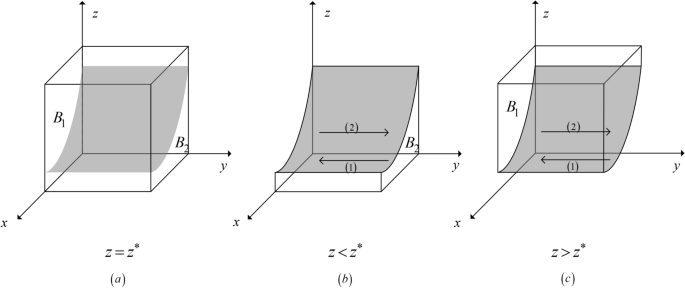
The phase diagram of the strategy evolution for the social organization.
When \(\frac\partial H\left( z \right)\partial z > 0\):
-
If \(z < z_2^*\), it follows that \(\left. \fracdF\left( y \right)dy \right|_y = 1 < 0\), and \(y = 1\) is ESS, as illustrated by arrow (2) in Fig. 3(b).
-
If \(z > z_2^*\), it follows that \(\left. \fracdF\left( y \right)dy \right|_y = 0 < 0\), and \(y = 0\) is ESS, as illustrated by arrow (1) in Fig. 3(c).
When \(\frac\partial H\left( z \right)\partial z < 0\):
-
If \(z < z_2^*\), it follows that \(\left. \fracdF\left( y \right)dy \right|_y = 0 < 0\), and \(y = 0\) is ESS, as illustrated by arrow (1) in Fig. 3(b).
-
If \(z > z_2^*\), it follows that \(\left. {\fracdF\left( y \right)dy} \right|_y = 1 < 0\), and \(y = 1\) is ESS, as illustrated by arrow (2) in Fig. 3(c).
Through the above calculations, we can obtain the Proposition 3.
Proposition 3:
If \(R_s > IQ\left( 1 – \lambda \right)\mkern 1mu \left( 1 – \alpha \right)\zeta\) and \(x\mkern 1mu > x_1^* = \fracI\widetildeQ\mkern 1mu \zeta \left( 1 – \alpha \right)I\widetildeQ\left( 1 – \alpha \mkern 1mu \right)\zeta + R_s – IQ\mkern 1mu \left( 1 – \lambda \right)\left( 1 – \alpha \mkern 1mu \right)\zeta \mkern 1mu \) are both met, \(\frac\partial H\left( z \right)\partial z < 0\). Otherwise, \(\frac\partial H\left( z \right)\partial z > 0\).
Proposition 3 indicates that if the reputational gains acquired by the social organization outweigh its losses incurred from low-quality service provider entering IESP, then the probability of the social organization participating in value co-creation increases as the probability of the service provider’s participation increases, provided that the digital technology company’s participation probability exceeds a certain threshold. Otherwise, the probability of the organization participating decreases as the probability of the service provider’s participation rises.
Thus, the reputational gains of the social organization serve as a pivotal factor in determining the full engagement of all stakeholders in value co-creation. This is rooted in the fact that the reputational gains are only achievable when all three parties actively participate in value co-creation, leading to the successful establishment of a high-satisfaction IESP. Such active involvement allows the social organization to achieve superior operational performance metrics, resulting in higher government ratings and more favorable policies. When reputational gains are substantial, even if the service provider is likely to offer high-quality services, the social organization remains motivated to enforce strict regulations, ensuring that no low-quality provider gains access to IESP. Conversely, when reputational gains are insufficient, the social organization may opt for relaxed oversight when the service provider tends to deliver high-quality services, thus reducing operational costs and exhibiting “free-rider” behavior. Therefore, the government must rigorously assess the ratings of social organizations and offer more favorable policies to those with higher ratings.
Strategic stability of the elderly care service provider
The expected revenues (\(E_31\), \(E_32\)) for the service provider when participating and not participating in value co-creation, as well as the average expected revenue (\(\overlineE_3 \)) are as follows:
$$\left\{ {\beginarray*20l \begingathered E_31 = xy\left( R_pH – C_pH + G_p + \Delta R_pH – C_p \right) + \left( 1 – x \right)y\left( R_pH – C_pH + G_p + \Delta R_p – C_p \right) \\ + x\left( 1 – y \right)\left( R_pH – C_pH + \Delta R_pH – C_p \right) + \left( 1 – x \right)\left( 1 – y \right)\left( R_pH – C_pH + \Delta R_p – C_p \right) \\ \endgathered \hfill \\ \begingathered E_32 = xy\left( R_pL – C_pL \right) + \left( 1 – x \right)y\left( R_pL – C_pL \right) \\ + x\left( 1 – y \right)\left( R_pL – C_pL + \Delta R_pL – C_p \right) + \left( 1 – x \right)\left( 1 – y \right)\left( R_pL – C_pL + \Delta R_p – C_p \right) \\ \endgathered \hfill \\ \overlineE_3 = zE_31 + \left( 1 – z \right)E_32 \hfill \\ \endarray } \right.$$
(7)
The replicator dynamic equation is expressed as:
$$F\left( z \right) = \fracdzdt = z\left( {E_31 – \overlineE_3 } \right) = z\mkern 1mu \left( 1 – z \right)\mkern 1mu \left( \begingathered C_pL – C_pH + R_pH – R_pL + \left( \Delta R_pH \mkern 1mu – \Delta R_pL \right)\mkern 1mu x \hfill \\ + \left( \Delta R_p \mkern 1mu + G_p – C_p \right)\mkern 1mu y + \left( \Delta R_pL \mkern 1mu – \Delta R_p \right)x\mkern 1mu y \hfill \\ \endgathered \right)$$
(8)
The first-order derivative of the replicator dynamic equation with respect to \(z\) is derived as:
$$\fracdF\left( z \right)dz = \left( 2\mkern 1mu z – 1 \right)\mkern 1mu J\left( x \right)$$
(9)
where \(\begingathered J\left( x \right) = – C_pL + C_pH – R_pH + R_pL – \left( \Delta R_pH \mkern 1mu – \Delta R_pL \right)\mkern 1mu x \\ – \left( \Delta R_p \mkern 1mu + G_p – C_p \right)\mkern 1mu y – \left( \Delta R_pL \mkern 1mu – \Delta R_p \right)x\mkern 1mu y \\ \endgathered\).
Through the similar solving process, we obtain \(J\left( x \right) = 0\) when \(x = x^* = \frac – C_pL + C_pH – R_pH + R_pL – \left( \Delta R_p \mkern 1mu + G_p – C_p \right)\mkern 1mu y\Delta R_pH \mkern 1mu – \Delta R_pL + \mkern 1mu \left( \Delta R_pL \mkern 1mu – \Delta R_p \right)y\mkern 1mu\), at which point \({dF\left( z \right) \mathord\left/ \vphantom dF\left( z \right) dz \right. \kern-0pt dz} \equiv 0\), indicating that the service provider is unable to determine a stable strategy. It can be deduced that \(\frac\partial J\left( x \right)\partial x = \Delta R_pL – \Delta R_pH + \left( \Delta R_p \mkern 1mu – \Delta R_pL \right)\mkern 1mu y < 0\). When \(x < x^*\), we derive \(J\left( x \right) > 0\) and \(\left. \fracdF\left( z \right)dz \right|_z = 0 < 0\), in which case \(z = 0\) becomes ESS for the service provider. Conversely, when \(x > x^*\), we obtain \(\left. \fracdF\left( z \right)dz \right|_z = 1 < 0\), meaning that \(z = 1\) is ESS. The phase diagram for the strategy evolution of the service provider is shown in Fig. 4.
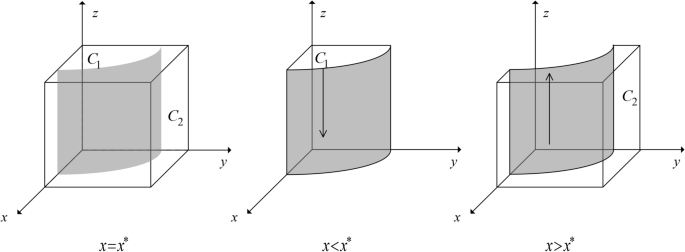
The phase diagram of the strategy evolution for the service provider.
Proposition 4:
During the evolutionary process, the probability of the elderly care service provider opting to engage in value co-creation increases as the participation probabilities of the other two parties rise.
Proposition 4 indicates that the stronger the willingness of the digital technology company and social organization to engage in value co-creation, the more inclined the elderly care service provider is to offer high-quality services. This is because when the digital technology company participates in value co-creation, it enhances the visibility of high-quality service provider by analyzing user feedback data, thereby widening the gap in market share and revenue between high-quality and low-quality service providers. Additionally, when the social organization imposes strict oversight on service provider, low-quality service providers are precluded from accessing IESP, depriving them of online customer acquisition opportunities. Therefore, increasing policy incentives for the digital technology company and social organization that participate in value co-creation can effectively encourage the elderly care service provider to improve service quality.
Proposition 5:
The probability of the elderly care service provider opting to engage in value co-creation strategies is positively correlated with the additional revenue generated by improving service quality (\(R_pH – R_pL\), \(\Delta R_pH \mkern 1mu – \Delta R_pL\)) and government subsidies (\(G_p\)), and negatively correlated with the costs of digital transformation for joining the platform (\(C_p\)) and the additional costs incurred in enhancing service quality (\(C_pH – C_pL\)).
Proposition 5 indicates that the service provider is incentivized to offer high-quality services only when improving service quality leads to higher profits. Therefore, enhancing the payment capacity of the elderly is a fundamental approach to improving the service quality. Additionally, the government can widen the income gap between high-quality and low-quality service providers by standardizing rating criteria and increasing incentives and financial subsidies for high-quality providers. For example, policies like the “reward instead of subsidy” initiative introduced by Shanghai can be effective.
Stability analysis of the system’s equilibrium strategies
Considering that the strategy set in this binary-choice game consists of participation or non-participation, we focus exclusively on the analysis of pure strategies. This approach is chosen to facilitate practical application and understanding, which is supported by many research findings54,55. From \(F\left( x \right) = 0\), \(F\left( y \right) = 0\) and \(F\left( z \right) = 0\), we can derive eight possible strategy combinations, namely \(\left( 0,0,0 \right)\), \(\left( 1,0,0 \right)\), \(\left( 0,1,0 \right)\), \(\left( 1,1,0 \right)\), \(\left( 0,0,1 \right)\), \(\left( 0,1,1 \right)\), \(\left( 1,0,1 \right)\) and \(\left( 1,1,1 \right)\). To determine the system’s equilibrium strategies, we first construct the Jacobian matrix, following the approach outlined by Friedman56.
$$J = \left[ {\beginarray*20c {{\partial F\left( x \right) \mathord\left/ \vphantom \partial F\left( x \right) \partial x \right. \kern-0pt \partial x}} & {{\partial F\left( x \right) \mathord\left/ \vphantom \partial F\left( x \right) \partial y \right. \kern-0pt \partial y}} & {{\partial F\left( x \right) \mathord\left/ \vphantom \partial F\left( x \right) \partial z \right. \kern-0pt \partial z}} \\ {{\partial F\left( y \right) \mathord\left/ \vphantom \partial F\left( y \right) \partial x \right. \kern-0pt \partial x}} & {{\partial F\left( y \right) \mathord\left/ \vphantom \partial F\left( y \right) \partial y \right. \kern-0pt \partial y}} & {{\partial F\left( y \right) \mathord{\left/ \vphantom \partial F\left( y \right) \partial z \right. \kern-0pt} \partial z}} \\ {{\partial F\left( z \right) \mathord\left/ \vphantom \partial F\left( z \right) \partial x \right. \kern-0pt \partial x}} & {{\partial F\left( z \right) \mathord\left/ \vphantom \partial F\left( z \right) \partial y \right. \kern-0pt \partial y}} & {{\partial F\left( z \right) \mathord{\left/ \vphantom \partial F\left( z \right) \partial z \right. \kern-0pt} \partial z}} \\ \endarray } \right] = \left[ \beginarray*20c J_11 & J_12 & J_13 \\ J_21 & J_22 & J_23 \\ J_31 & J_32 & J_33 \\ \endarray \right]$$
where \(J_11 = \left( 2\mkern 1mu x – 1 \right)\mkern 1mu \left( – L_d + \Delta C_d \mkern 1mu \beta + \left( \beta – 1 \right)\Delta C_d \mkern 1mu y – R_d \mkern 1mu y\mkern 1mu z – IQ\lambda \mkern 1mu \left( \mkern 1mu \alpha \mkern 1mu \zeta + y\left( 1 – \mkern 1mu \alpha \zeta \right) + \mkern 1mu \mkern 1mu \left( 1 – \mkern 1mu \alpha \right)\left( 1 – y \right)\zeta z \right) \right)\),\(J_12 = x\mkern 1mu \left( 1 – x \right)\mkern 1mu \left( \left( \beta – 1 \right)\Delta C_d \mkern 1mu + IQ\lambda \left( 1 – \mkern 1mu \alpha \mkern 1mu \zeta + \mkern 1mu \left( \alpha \mkern 1mu – 1 \right)z\mkern 1mu \zeta \right) + R_d \mkern 1mu \mkern 1mu z \right)\), \(J_13 = x\mkern 1mu \left( 1 – x \right)\mkern 1mu \left( IQ\zeta \lambda \mkern 1mu \left( 1 – \mkern 1mu \alpha \right)\left( \mkern 1mu 1 – \mkern 1mu y\mkern 1mu \right) + R_d \mkern 1mu y \right)\), \(J_21 = y\mkern 1mu \left( 1 – y \right)\mkern 1mu \left( \left( IQ\left( 1 – \lambda \right) – I\widetildeQ \right)\left( 1 – \alpha \zeta \right) + \left( I\widetildeQ\left( 1 – \alpha \right) + \mkern 1mu \left( \lambda – 1 \right)\mkern 1mu \left( 1 – \alpha \right)IQ \right)\mkern 1mu z\zeta + R_s z \right)\), \(J_22 = \left( 2\mkern 1mu y – 1 \right)\mkern 1mu \left( \begingathered – L_s + \Delta \textC_s – I\widetildeQ\left( 1 – \alpha \mkern 1mu \zeta \right) – \left( IQ\left( 1 – \lambda \right) – I\widetildeQ \right)\left( 1 – \alpha \zeta \right)x + I\widetildeQ\left( 1 – \alpha \right)\zeta \mkern 1mu z \\ \mkern 1mu – \left( I\widetildeQ\left( 1 – \alpha \right) + \mkern 1mu \left( \lambda – 1 \right)\mkern 1mu \left( 1 – \alpha \right)IQ \right)\zeta x\mkern 1mu z – R_s x\mkern 1mu z \\ \endgathered \right)\), \(J_23 = y\mkern 1mu \left( 1 – y \right)\mkern 1mu \left( – I\widetildeQ\zeta \left( 1 – \alpha \right) + \left( I\widetildeQ\left( 1 – \alpha \right) + \mkern 1mu \left( \lambda – 1 \right)\mkern 1mu \left( 1 – \alpha \right)IQ \right)x\zeta \mkern 1mu + R_s x \right)\), \(J_31 = z\mkern 1mu \left( 1 – z \right)\mkern 1mu \left( \Delta R_pH \mkern 1mu – \Delta R_pL + \left( \Delta R_pL \mkern 1mu – \Delta R_p \right)\mkern 1mu y \right)\), \(J_32 = z\mkern 1mu \left( 1 – z \right)\mkern 1mu \left( \Delta R_p \mkern 1mu + G_p – C_p + \left( \Delta R_pL \mkern 1mu – \Delta R_p \right)x\mkern 1mu \right)\), \(J_33 = \left( 2z – 1 \right)\left( – C_pL + C_pH – R_pH + R_pL – \left( \Delta R_pH \mkern 1mu – \Delta R_pL \right)\mkern 1mu x – \left( \Delta R_p \mkern 1mu + G_p – C_p \right)\mkern 1mu y – \left( \Delta R_pL \mkern 1mu – \Delta R_p \right)x\mkern 1mu y \right)\).
According to Lyapunov’s system stability theory, an equilibrium point can be determined as an ESS if all the eigenvalues of the Jacobian matrix have negative real parts. The stability analysis of the strategy combinations is presented in Table 3.
Proposition 6:
If \(D_2 < 0\), it can be inferred that \(D_1 > 0\), \(D_3 > 0\), \(D_4 > 0\),\(D_6 > 0\), \(D_5 < 0\), \(D_7 < 0\) and \(D_8 < 0\).
Corollary 6 indicates that when \(D_2 < 0\) is satisfied, the digital technology company’s stable equilibrium strategy in pure strategy combinations will always be to engage in value co-creation, regardless of the choices made by the other two parties. This is because \(D_2 < 0\) represents the minimum additional benefit that the digital technology company can obtain by participating in value co-creation (the additional benefit gained when the digital company chooses to participate while the other two parties do not), which still exceeds the loss incurred if it does not participate. Notably, reducing the operational costs incurred by the digital company’s participation, increasing the sales volume and commission on IESP, as well as the profit distribution ratio for the digital company, and enhancing the reputational damage suffered by the digital company when it chooses not to participate, can all contribute to the fulfillment of \(D_2 < 0\).
Proposition 7:
If \(S_6 < 0\), it can be inferred that \(S_1 > 0\), \(S_2 > 0\), \(S_4 > 0\), \(S_7 > 0\), \(S_3 < 0\), \(S_5 < 0\) and \(S_8 < 0\).
Proposition 7 suggests that when \(S_6 < 0\) condition is met, regardless of the choices made by the other two parties, the stable equilibrium strategy for the social organization in a pure strategy combination is to participate in value co-creation. Unlike the digital technology company, the minimum likelihood for the social organization to engage in value co-creation does not arise when the other two parties are absent, but rather when the service provider participates while the digital technology company does not. This is evident in the fact that \(S_3 < 0\) is more relaxed than \(S_6 < 0\). When the service provider actively participates in value co-creation by offering high-quality services, the social organization’s lack of stringent supervision does not negatively impact IESP’s reputation or reduce its revenue, making the incentive for the social organization to participate in value co-creation lower than when the service provider does not participate. When the condition \(S_6 < 0\) is met, ensuring that the social organization’s benefits from participating in value co-creation exceed those of not participating, the organization will invariably choose to engage in value co-creation. As IESP sales increase through digital cognitive training, the extra costs of participating in value co-creation decrease, and the reputation loss for not participating grows, making it easier to meet condition \(S_6 < 0\).
Proposition 8:
If \(P_4 < 0\), it can be inferred that \(P_1 > 0\), \(P_2 > 0\) and \(P_7 < 0\). If \(P_6 < 0\), it can be inferred that \(P_3 > 0\), \(P_5 > 0\) and \(P_8 < 0\). When \(\Delta R_p + G_p – C_p > 0\), \(P_4 < 0\) implies \(P_6 < 0\).
Proposition 8 demonstrates that when the digital technology company engages in value co-creation, the constraints required to achieve the service provider’s participation in value co-creation are more relaxed than when the digital company does not participate. This implies that the involvement of the digital company can encourage the service provider to adopt a participatory strategy. Specifically, when the sum of the minimum online income earned by the high-quality service provider and government subsidies exceeds its digital transformation costs (i.e., \(\Delta R_p + G_p – C_p > 0\)), \(P_4 < 0\) can deduce \(P_6 < 0\), suggesting that the participation of the social organization can motivate the service provider to choose a participatory strategy. This is because, under such conditions, the service provider has the incentive to join IESP, and the rigorous supervision of the social organization makes delivering high-quality services a prerequisite for the service provider to access IESP. Conversely, when the digital transformation costs for the service provider are higher, the provider lacks the motivation to join IESP. Therefore, in addition to increasing the profit margin between high-quality and low-quality offline services to satisfy the condition \(P_4 < 0\), it is also crucial to enhance the service provider’s online revenue, increase government subsidies for high-quality service providers, and reduce the digital transformation costs for the service provider.
Proposition 9:
When Condition 8 is satisfied, the system reaches an ideal state, where the evolutionarily stable strategy for all three parties is to engage in value co-creation. Additionally, Condition 2 and Condition 8 may coexist, as may Conditions 3, 4, and 8. To ensure that the system evolves toward the ideal state, i.e., to ensure that only Condition 8 is satisfied, it is necessary to maximize \(R_d\), \(R_s\), \(G_p\) and \(\Delta R_pH\), while minimizing \(C_p\).
We can find that, compared to the strictest constraints outlined in Proposition 6 to 8 that compel a single party to engage in value co-creation, the constraints in Condition 8 are somewhat relaxed in achieving the participation of all parties in value co-creation. This implies that when all three parties choose to engage in co-creation, a win-win situation can be realized. To achieve this ideal state, it is necessary to enhance the reputational benefits for the digital technology company and the social organization, increase subsidies for high-quality service providers, widen the income gap between high-quality and low-quality service providers, and reduce the digital transformation costs for the service providers.
link