

On February 18, the BC government will release the provincial budget, outlining its priorities for the upcoming year. Despite the role of seniors’ care as a foundational part of the public health care system, these services have not received the attention they require in past provincial budgets.
This is shortsighted considering that accessible and appropriately resourced seniors’ care can help prevent and reduce demand on more expensive parts of the public health care system, including emergency and hospital services. But more than that, these services help older adults maintain their dignity and independence longer in the community.
Six previous CCPA reports – published in 2000, 2005, 2009, 2012, 2017, and 2020 – documented declining access to publicly funded seniors’ care services in BC, including home care, assisted living, and long-term care. The 2017 report found that underfunding, privatization, and system fragmentation left many seniors, their families, and communities patching together care – and even going without.
How does access to the publicly funded spectrum of seniors’ care services look today? Let’s take a look.
Since the CCPA’s 2017 report, the BC Office of the Seniors Advocate has published an annual Monitoring Seniors Services in BC report. In the most recent edition, published in August 2025, the BC’s Advocate found:
- The rate of home support clients per 1,000 seniors (75+) decreased seven per cent and the average hours per client decreased two per cent over the last five years.
- The number of Adult Day Program clients and program days fell five per cent and 11 per cent, respectively, since 2019-20.
- The waitlist for publicly funded registered assisted living increased by 37 per cent over the last five years, while the rate of publicly subsidized units per 1,000 seniors (75+) decreased 15 per cent.
- From 2016 to 2025, the number waiting to be admitted to long-term care increased from 2,381 to 7,212 people, an increase of 200 per cent.
In a January 2026 update, the Advocate found that there has been a 19 per cent increase in the population of seniors 65+ since 2019-20, but only a five per cent increase in the number of publicly funded long-term care beds. The provincial government’s own data show that 16,000 additional long-term care beds will be needed over the next decade, but that the government has no plans to meet the demand.
These are alarming numbers. Considering that BC hospitals face severe strain, the lack of planned investment in seniors’ care is a serious problem. If the provincial government has no plans to sufficiently address increasing demand for public care, how are these gaps being filled?
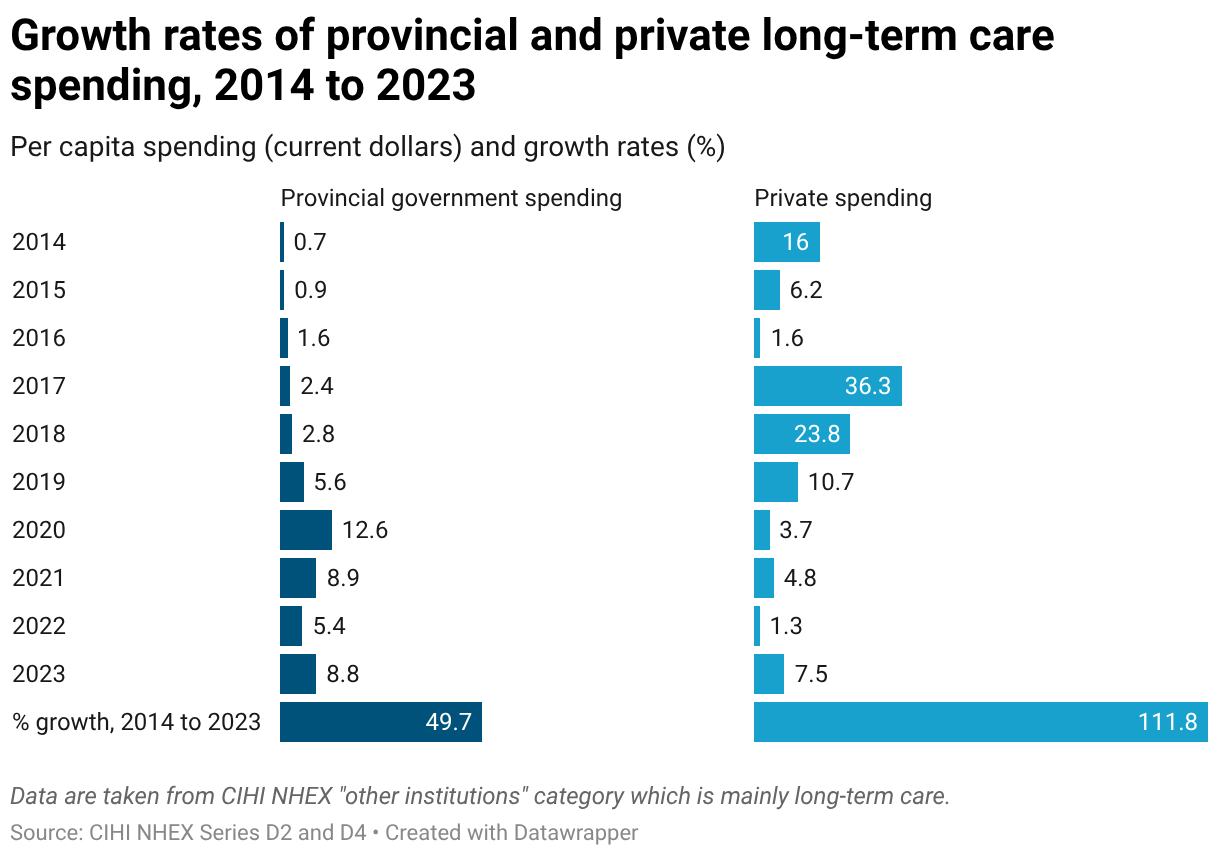
Increasing private, out-of-pocket spending on seniors’ care is one of the main indicators that the publicly funded system is not meeting the needs of British Columbians. Private spending on long-term care has outpaced public long-term care investment. From 2014 to 2023, per capita private spending increased by 112 per cent while public spending increased by only 50 per cent. Private spending comes in the form of out-of-pocket household and private insurance payments to obtain long-term care.
These figures show how declining access to publicly funded long-term care benefits the private-pay long-term care market where families often pay thousands of dollars to receive private long-term care. Contrary to some characterizations, many BC seniors are low-income and simply do not have the resources to afford private-pay care.
On a positive note, there has been increased public investment in long-term care since the start of the pandemic, although spending growth in the most recent year available–2023–declined to 8.8 per cent from a high of 13 per cent growth in 2020. Clearly, investments are not near where they need to be to increase the number of long-term care beds to meet demand over the next decade.
What we need from the BC budget
The BC budget should prioritize investment in publicly funded and not-for-profit seniors’ home and community care. Since 2017, access to public seniors’ care is getting worse. While it may be tempting for the BC government to reduce spending on seniors’ care, BC still spends less as a share of GDP on social programs than it did during the 1990s. BC is a wealthy province and the provincial government is taking in much less revenue as a share of economic activity than it did in decades past.
Over the last few years, there have been welcome steps from the BC government to address the harms of privatization in home support and long-term care sectors, including service fragmentation and workforce instability.
However, there is more work to both improve working conditions, reduce the reliance on for-profit corporations, and increase access to vitally important seniors’ care services. This means a multi-year plan to build and expand publicly funded home care services, assisted living, long-term care, and community programs. The growth of private payment for seniors’ care only widens inequities in our health care system – and leaves a growing number of seniors without access to care altogether.
Although seniors’ care is not a panacea for hospital overcrowding, the BC government should recognize that upstream investments in seniors’ care can help reduce hospital strain. This is especially important at a time when many hospitals are dangerously beyond capacity.
link