
Theoretical framework
Social support theory posits that social networks can provide individuals with emotional, material, and informational support when facing pressure and challenges in life, enhancing mental well-being through both direct and buffering effects. Social support plays a crucial role in buffering individuals from the potentially harmful effects of stressful experiences (Cohen & Wills, 1985), including stress related to aging, such as declining physical health and a shrinking social network. It serves as a protective factor by mitigating stress-related threats to self-esteem and feelings of helplessness while also providing a compensatory function (Cohen & Wills, 1985). This indicates that social support can help older adults navigate uncertainty, achieve positive outcomes, and regain a sense of control and self-worth that may have been diminished with age (O’Brien & Sharifian, 2020). As a result, it can contribute to a more positive perception of themselves and the aging process.
The crowding-in versus crowding-out framework helps explain how participation in government-sponsored elderly privilege program affects support from adult children. The crowding-out perspective suggests that frequent use of the program reduces older adults’ reliance on their children, while the crowding-in perspective argues that such participation may actually encourage family involvement and support (He et al., 2021). Consequently, engaging in elderly privilege program can generate new emotional and financial needs, potentially influencing whether adult children increase or decrease their support for aging parents.
Using elderly privilege program and older adults’ positive attitudes toward aging
To ensure the basic living needs of older adults in China, the government has implemented various institutional arrangements to address the weakening of traditional family support caused by modernization and industrialization. These measures include social pension and medical insurance, community-based elderly care services, and elderly privilege program. The elderly privilege program is based on older adults’ actual needs. It aims to enhance overall well-being of older adults by improving living environment, increasing access to public services, and offering economic and emotional support in areas such as healthcare, transportation, and entertainment. Friendship networks help alleviate stress and depression (Bankoff, 1983; Litwin, 2001), benefiting older adults’ mental health. However, these networks are vulnerable to erosion by stressful late-life events like widowhood and retirement (Bao et al., 2021). Social support serves as a vital system for maintaining mental well-being in older adults, closely linked to their attitudes toward aging (Rashid et al., (2014)). Elderly privilege program promotes older adults’ social interaction outside the house, helping maintain and broaden their social networks and gain social support. This enhanced social connectivity and social support can improve emotional communication and instrumental support, potentially fostering positive aging attitudes (Lamont et al., 2017).
Attitudes toward aging (or self-perceptions of aging/satisfaction with aging) in older adults encompass their cognitions and expectations regarding the aging process (Jung & Siedlecki, 2018). Attitudes toward aging are generally classified into two dimensions: positive and negative (Laidlaw et al., 2007). A positive attitude toward one’s own aging can promote successful aging among older adults (Baltes & Smith, 2003), is a strong predictor of higher level of life satisfaction (Tao & Li, 2016; Wang, 2011) and is helpful in reducing mental illness among older adults (Yuan & Shen, 2016). Therefore, it is important to examine what factors contribute to older adults’ positive attitudes toward aging. However, few studies have specifically investigated the link between using elderly privilege program and positive aging attitudes in Chinese older adults. Based on the benefits of using elderly privilege program on other aspects of older adults’ life, we proposed the hypothesis:
H1: There would be a positive association between using elderly privilege program and positive attitudes toward aging among Chinese older adults.
Support from adult children and older adults’ positive attitudes toward aging
Previous studies mainly examined how adult children’s support influenced older adults’ mental health. Substantial evidence indicates that financial support from children significantly enhances parental life satisfaction (Silverstein et al., 2006b; Lin et al., 2011). More emotional support from children could improve psychological well-being of older adults (Silverstein et al., 2006a), and instrumental support from children was helpful to mitigate depression among older parents (Cong & Silverstein, 2008). However, Abolfathi Momtaz et al. (2014) found that excessive support (financial, care, and concern) from adult children could compromise older adults’ self-esteem and well-being. Because it made older adults feel that they were useless and became a burden for their children.
Relatively limited research has explored the influence of support from adult children on older adults’ positive aging attitudes. One study showed that children’s support significantly enhanced positive aging attitudes among Chinese older adults, with emotional support being strongest, followed by instrumental and financial support (Sun, 2017). Another study categorized older adults’ attitudes toward aging into three types (psychological loss, positive psychological acquisition, and coping with body changes with aging), and found that emotional and instrumental support from children were helpful to promote positive psychological acquisition among older adults, and emotional support also had a positive effect on coping with body changes with aging among older adults (Wu & Li, 2019). Therefore, researchers generally believe that adult children’s support enhances positive aging attitudes among older adults. This effect is largely rooted in filial piety—a traditional cultural obligation for Chinese children to respect and take care of their parents (Silverstein et al., 2006b)—and the institutional norm, legally mandated in China, of adult children supporting their older parents. Chinese older adults mainly rely on their children for old age support and usually hold high expectations on getting support from their children (Xu & Chi, 2016; Xu et al., 2017). Therefore, we proposed the following hypotheses:
H2a: Financial support from adult children would have a significant positive influence on positive attitudes toward aging among Chinese older adults.
H2b: Instrumental support from adult children would have a significant positive influence on positive attitudes toward aging among Chinese older adults.
H2c: Emotional support from adult children would have a significant positive influence on positive attitudes toward aging among Chinese older adults.
The mediating role of support from adult children
Among the multiple factors that influence support from adult children, social welfare is considered as a critical factor. For example, one study showed that intergenerational support rate was lower in western countries with better social security and services for older adults (Katz, 2009). Reil-Held (2006) found that public financial transfers provided to older people in German might lead to a reduction in the private financial support they would have otherwise obtained. Jiao (2016) found that new rural social pension insurance in rural China had crowding-out effect on emotional and instrumental support from adult children. Chen and Zeng (2013) also found that the pension received by older adults increased by 1 RMB was associated with a 0.808 RMB decrease in adult children’s financial support. However, Chen et al. (2017) reported that greater social welfare provisions for older adults predicted greater financial transfers from adult children to older parents. This implies that there is a relationship between using elderly privilege program and adult children’s support. Based on the analysis, we proposed the following hypotheses:
H3a: Financial support from adult children would mediate the association between using elderly privilege program and positive attitudes toward aging among Chinese older adults.
H3b: Instrumental support from adult children would mediate the association between using elderly privilege program and positive attitudes toward aging among Chinese older adults.
H3c: Emotional support from adult children would mediate the correlation between using elderly privilege program and positive attitudes toward aging among Chinese older adults.
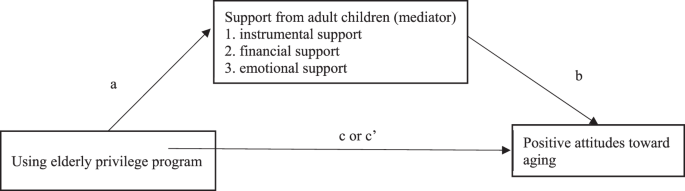
Building on hypotheses 1–3, we proposed a conceptual framework (Fig. 1) depicting the relationship between using elderly privilege program and positive aging attitudes among Chinese older adults, along with the potential mediation by different forms of adult children’s support.

a The relationship between using elderly privilege program and adult children’s support; b The relationship between adult children’s support and positive attitudes toward aging.
link